

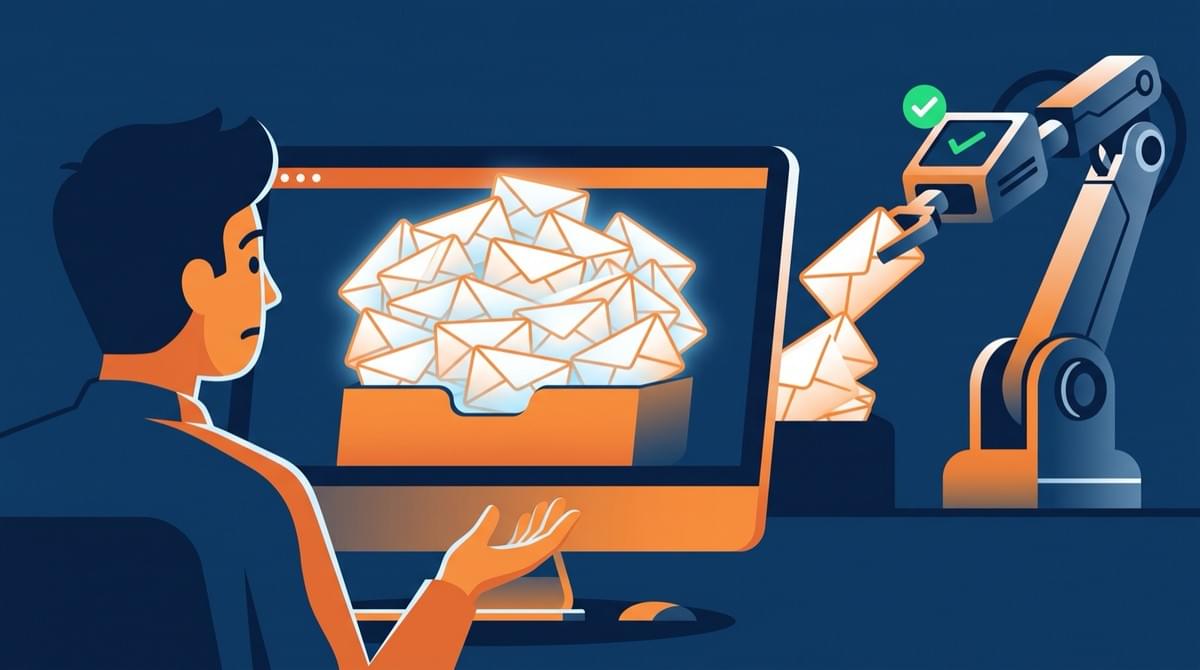
Our client opened their inbox that afternoon and found thirty emails from us.
Each one opened with a different name. Some were addressed to them. Some to their colleagues. Some to people they had never heard of. All thirty arrived in the same inbox.
The client sent back one line: "Did something go wrong on your end?"
We went to check. What we found was almost funny.
We had asked an AI agent to send personalised project updates to thirty clients. The instruction was explicit: "Send to each of the thirty clients separately. Each client receives only their own update."
The agent did exactly that. It sent all thirty messages.
To the same person. Every message carried a different name in the greeting. The inbox never changed.
Nothing errored. The agent considered the job done. All thirty emails left the building. We only found out because the client told us.
What Actually Happened
We were testing a new automation workflow, built to take the grind out of client communication.
The task was simple. Thirty clients needed their own project status update. Done by hand, that is thirty rounds of copy, check, send. It looked like exactly the kind of repetitive work an AI agent should own.
So we wrote the brief: "Send project updates to the following thirty clients separately. Each client's message should include their name, their project, and current progress. Make sure each client receives only their own information."
The agent took the brief and executed. From its point of view, the task was a success: thirty messages sent, zero errors.
What it never grasped was what separately and only their own information actually required. It understood one action — send — and performed that action thirty times.
At no point in the chain did anything tell it: before you send, confirm that these thirty messages map to thirty different people.
Where It Broke
Looking back, the fault was not in the AI, and not in any one person. It was in how we designed the workflow.
First, an agent executes instructions. It does not interpret them.
An AI agent is good at doing. It is not doing the understanding for you. It will not ask whether the task has an unstated precondition. It will not pause before sending to ask, "Are you sure these thirty messages belong to thirty different people?"
It knew the action send had to happen thirty times. Who received it was not its concern — and it saw no reason it should be.
Second, there was no verification step in the pipeline.
The design ran: read the data, generate the message, send. Between generate and send, one step was missing — check.
Nobody told the agent to compare the recipient list before sending. Nobody told it that if every recipient turned out to be the same person, it should stop and ask whether that was normal.
We assumed it would understand. It didn't. That is not its failing. It is ours — we left the checking step out of the design.
Third, nothing errored. Technically, everything was fine.
Thirty messages sent. No exceptions, no warnings, no anomalies. From the system's point of view, this was a flawless run.
The problem was not technical. It was in the business logic — and business logic is precisely where AI is weakest.
Fourth, responsibility became ambiguous.
The agent has no sense of "I may have got this wrong." It will not volunteer, "Hold on, let me verify the recipients." It executes. And when execution goes wrong, it carries no liability. The people who deployed it do.
It Isn't the AI's Fault. It's Ours.
The lesson landed clearly: AI does not understand tasks. It executes instructions.
When we hand a task to AI, what we have in mind is "send this information to thirty people." What the AI receives is "send thirty times." The distance between those two sentences is the distance between understanding and execution.
The same gap exists in translation and localisation.
AI can translate a 5,000-word document in a minute — but it will not tell you that a sentence carries cultural risk in the target market. It can produce product descriptions in ten languages at once — but it will not flag that the Japanese and German versions disagree on a number. It can proofread a translation — but it will not volunteer, "I'm not confident about this paragraph; it needs a human."
AI can execute. It cannot judge. And judgement is the one part of business you cannot skip.
AI Can Accelerate. It Doesn't Care.
Not long ago I read a designer speaking on a panel about whether AI would replace human work. One line stayed with me.
He said AI can genuinely speed things up — sketches, renders, options, all of it. But there is one thing it does not have: the human capacity to care about the work.
People don't just finish things. We lose sleep over a detail that isn't right. We redo a layout over a one-pixel drift. We feel pride or regret about how a project finally turned out. AI has none of that.
That line went straight to my own industry.
AI can translate, and it gets faster and better every quarter. But it will not sit with a term that isn't quite right and keep digging. It will not read a client's thank-you note and feel the work was worth it. It will not feel uneasy about a cultural detail it may have mishandled.
That is not a technology gap. It is a caring gap.
AI can accelerate execution. Only people care about the outcome.
What does caring look like in translation and localisation?
A translator hits a term that feels wrong and stops — looks it up, checks prior cases, asks a colleague. "Close enough" is not an option.
A project manager finishes delivery and still goes back to ask whether a phrase will land badly in the target market — rather than assuming that because the AI finished, the job is done.
A team finds and fixes a problem before the client reports it, rather than waiting for the complaint.
What these have in common: nobody asked for it, and somebody did it anyway. Because they cared whether it was good.
AI doesn't care. That is why AI can take on a great deal of work, and still cannot replace a person's care for the craft, ownership of the result, or obsession with the detail.
Three Lessons
Lesson one: before automating a task, ask whether it has a verification step.
Not every task needs one. Drafting, list-making, translating something low-stakes — those can be done and then checked.
But anything touching external communication, client data, contracts, or financial figures needs verification. And not "the AI checks itself" — a person checks what the AI did.
Lesson two: AI will never say "I might be wrong," so you have to install the checkpoints yourself.
When you design a workflow, do not assume the AI understands your intent. Every point that requires judgement should become an explicit checkpoint.
Confirm the recipient list before sending. Verify critical numbers before publishing. Spot-check terminology consistency after translating. These checkpoints don't need to be elaborate. They need to exist.
Lesson three: AI carries no responsibility. The people and companies deploying it do.
In our email incident, the agent "completed the task" with no negligence of any kind. But our client was never going to complain to the AI. They complained to us.
We were the ones whose trust was damaged. We were the ones who paid to repair the relationship. In business, AI has no concept of responsibility. People do. And that responsibility cannot be automated away.
Back to Language Services
This happened inside our own operations, but it clarified something we already half-knew: translation and localisation are, at bottom, precision work.
A product manual with one mistranslated term can cause a user to operate equipment wrongly. A multilingual contract with one skewed figure can trigger a legal dispute. A multilingual website with one cultural misstep can become a PR crisis.
AI can speed all of this up. It cannot decide for you whether the translation is right, whether the number is accurate, or whether the phrasing works in that market.
More to the point, it will not care about any of it.
It will not keep reworking a term that isn't precise. It will not reopen the whole process because of one line of client feedback. It will not feel uneasy after a mistake and then build a safeguard so it never recurs.
People do.
That is why, when we built our own TMS, verification sat at the centre of the design — not out of distrust of AI, but because we know where it fails, and we wanted a way to stop it before it did.
Clients don't choose us because we "use AI." Everyone uses AI. They choose us because we know where AI breaks, and we have a way to keep it from breaking.
And underneath that: we care.
The Last Word
AI can send thirty emails for you. It will not stop to ask whether those thirty emails were meant for thirty different people.
AI can translate into a hundred languages. It will not lose sleep over the one word that isn't quite right.
AI can accelerate every part of execution. It will not care about the result.
In business, AI has no concept of responsibility. People do.
Which is why every AI-driven process still needs a human judgement left inside it.
And why we still need people who care about their work.