

When you hit "publish" in your website's backend, can five different language versions update simultaneously while maintaining a consistent brand voice? This isn't magic—it's the science of integration.
Late at night, the overseas digital team of a Chinese new energy vehicle company is in disarray. They updated the battery specifications for the latest model in their Chinese CMS (Content Management System), but the description on the German website remains outdated, the Spanish site translates "fast charging" literally as "angry charging," and the French launch date is delayed by a week.
This scenario epitomizes the disorder of multilingual content management. In global operations, companies often find themselves trapped in this dilemma: the marketing team is eager to publish news, local teams are waiting for translations, and the IT department is exhausted shuttling content between different systems—resulting in a disjointed brand presence on the global stage.
1. The Pain of Integration: Three Challenges in Multilingual Content Management
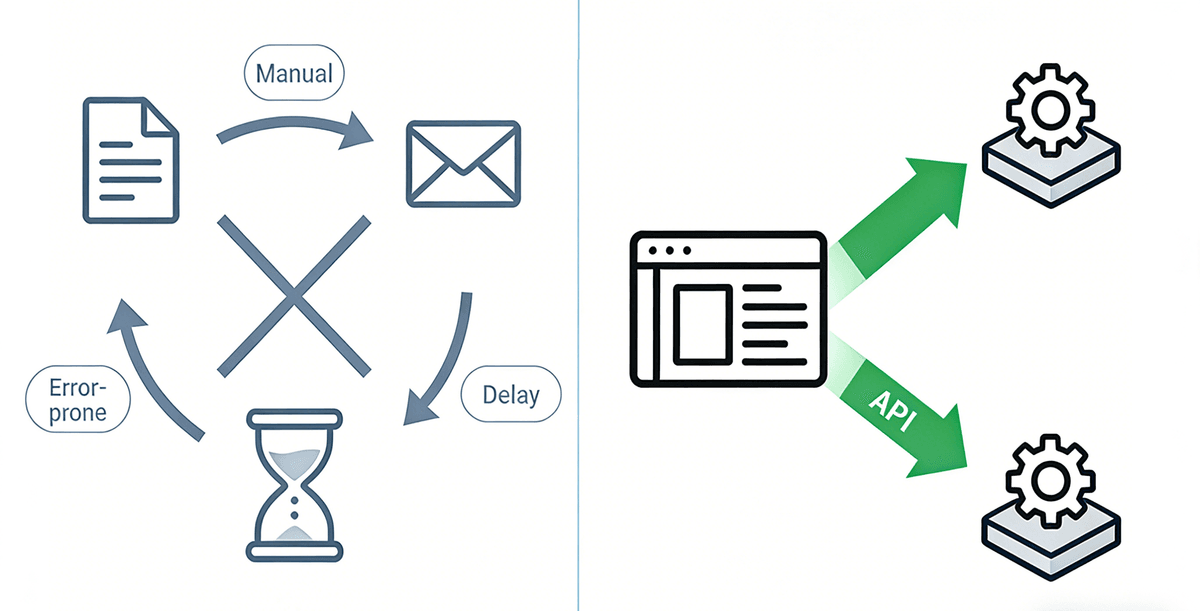
Behind the technical term "CMS integration" lie the real pain points of a company's global content flow. The multilingual workflow adopted by most companies can be summarized as a manual "download-translate-upload" model, which triggers three core issues:
Information Lag & Content Desynchronization
Marketing campaigns are often highly time-sensitive. While the main English site is already预热 (warming up), other language versions may still be waiting in the translation queue, allowing business opportunities to slip away during the wait. Research on multinational corporations shows that up to 67% of non-English content launches experience significant delays, averaging over 5 business days.
Difficulty Maintaining Brand Consistency
When "smart driving" is translated as "autonomous driving" in German and becomes "driving assistance" in Japanese, the unified technical image the brand intends to convey is actually fragmented. The absence or unenforced use of a terminology glossary means the same product "speaks different languages" in different markets.
Hidden Rise in Operational Costs
Marketing, translation, and IT teams waste immense effort switching between emails, spreadsheets, and different platforms. More critically, this fragmented process makes it difficult to effectively accumulate and reuse Translation Memory, causing companies to repeatedly pay for translating the same content.
2. Engine Principles: How Professional Translation Integrates Seamlessly into Your Content Flow
The real solution is to turn professional language services into a built-in feature of your CMS, not an external add-on process. This is like installing a precise "translation engine" into your global content pipeline.
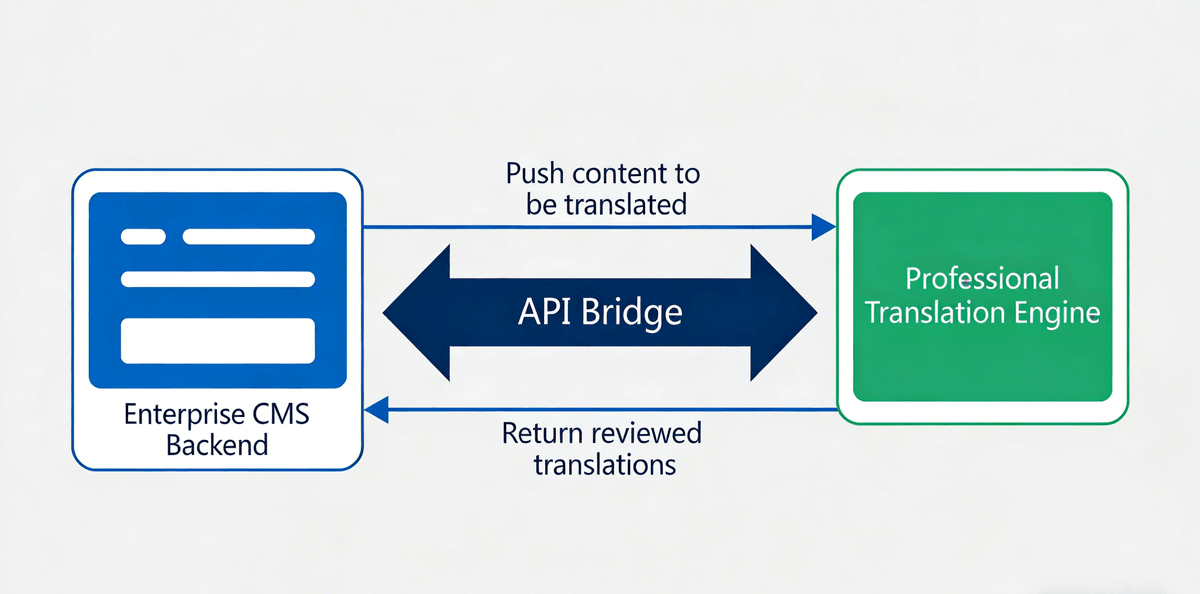
The core is deep API integration. Through secure Application Programming Interfaces, your CMS (e.g., WordPress, Sitecore, Adobe Experience Manager) can communicate directly with the platform of a professional translation provider (like iCentech). After an editor marks content for localization in the CMS and clicks "send for translation," the system automatically executes the following workflow:
- Intelligent Content Extraction & Packaging: The system automatically identifies and extracts new or modified text, text within images, and even metadata, packaging it into a translation task.
- Pre-translation Terminology & Style Validation: Before dispatch, the task is compared against your pre-configured, integrated brand terminology database and style guide to ensure baseline consistency.
- Automatic Routing to Professional Workflow: The task enters the translation vendor's optimized workflow, assigned to the most suitable professional vocabulary translation team. For instance, automotive technical content is automatically assigned to a translation group with an engineering background, adhering to specific quality standards like those for an automotive manual translation project.
- Automatic Return & Publishing of Translated Copy: The reviewed translation is automatically returned via API to its corresponding location in the CMS, entering a pre-set publishing queue or awaiting final approval. Throughout this process, your team never needs to leave the familiar CMS environment.
3. Guardians of Consistency: Terminology & Style Governance in Integrated Systems
The higher-order value of integration lies in proactive quality control. In traditional models, terminology checking heavily relies on the subjective experience and diligence of translators and reviewers. In an integrated system, this becomes an enforceable technical rule.
A "Terminology Validator" can be deployed at the system level. When a translation contains a term that doesn't match the central terminology database, the CMS backend will flag a warning, much like a spell-checker. Depending on the rules, it can even prevent non-compliant translations from proceeding.
Take an automotive maintenance manual translation case: when the manual mentions "regenerative braking," the system would enforce the use of the standard translation "能量回收制动" (energy recovery braking) from the central library, rather than other possible terms like "再生制动" or "反馈制动". This "hard constraint" ensures the uniformity and professionalism of global technical documentation from the source.
4. The Efficiency Revolution: From Manual Handling to Automated Value Creation
Process automation liberates productivity. Marketing personnel are freed from tedious coordination tasks to focus more on content strategy itself. IT staff no longer need to manually export and import files, reducing operational errors.
A deeper efficiency gain is seen in the economies of scale for cost. The integrated system meticulously records every translation task, building a company-specific, ever-enriching Translation Memory. When the CMS later contains identical or similar sentences (e.g., product disclaimers, standard operating procedures), the system automatically suggests reuse, directly reducing the word count and cost of translation. For companies with frequent content updates, this can lead to long-term savings of 20%-40% on localization expenses.
5. The Future Vision: Strategic Extensions of Intelligent Integration
Modern integration extends beyond text. As content formats diversify, advanced integration solutions can handle multimedia assets within the CMS. Uploading an English product video can automatically trigger a workflow for subtitle translation, voice-over script creation, and multilingual subtitle file generation.
Going further, integration is converging with artificial intelligence. For low-risk, highly repetitive content (like updated product specification parameters), the system can be configured for an "AI-first" workflow: a machine translation engine generates a first draft quickly, followed by light human post-editing (MTPE), significantly increasing delivery speed while maintaining baseline quality.
After that new energy vehicle company's team finally achieved synchronized publishing and unified management of content in Chinese, English, German, Spanish, and French through a deep integration solution, their Global Digital Marketing Lead remarked: "We are no longer just 'content movers,' but true 'global content curators.'"
In the latter half of global competition, the efficiency and consistency of content publishing are, in themselves, a core competitive advantage. Streamlining Multilingual CMS Integration is fundamentally about building a seamless, precise, and efficient technical artery for a company's global communication system. It ensures that every localized launch is not the end of a long journey, but an agile, collaborative synchronization of global value.